


“Undercover” Pop Music Royalty: The Real Hit Makers

Hal Blane
“Who Is The Wrecking Crew?”
After a quick Google search, you’ll most likely find “The Wrecking Crew” defined as a loosely connected, but very prolific group of LA session players of the '60s. While that’s an accurate description, it’s short of the mark, and more than a little misleading. The non-contractual affiliation among band members and the lack of any “leader” probably differ from what most listeners perceive as a “traditional” group. However, by Music Industry standards, this kind of band is as traditional as it gets.
During their most vital years, the band had a total “membership” of well over 60 musicians at any given time. Though that may seem like a lot of players to qualify as a pop/rock band, that number mainly reflects the brass, winds, and orchestral string players on call as needed. The heart of the band (Drummers, Guitarists, bass, and keyboard players) consisted of about 10-15 tightly knit players who worked together day after long day. This intensive, ongoing collaboration among such talented and disciplined professionals cultivated musical bonds, well beyond what most “organically” formed bands of pop stars could ever hope to acquire.
Long before they were known as “The Wrecking Crew,” music industry colleagues referred to them as “the first call gang,” or simply “the regulars,” based on how often the core players collaborated. Although it might be hard to imagine, it’s these “regulars” who are the most-recorded and most-successful hit-generating group in pop music history.
Due to the passage of time and the astounding volume of material, it’s impossible to count the exact number of hits they’ve helped create. However, it's estimated that core members of the “Wrecking Crew” have been contracted to perform on over 10,000 recording sessions. What’s even more challenging to quantify is the band's potent and lasting impact on virtually every far-flung corner of pop culture music. Believe it or not, it was The Wrecking Crew behind the bounce of Nancy Sinatra’s bubblegum classic, These Boots Are Made for Walkin’ as well as the intricate runs on Frank Zappa’s avant-garde “Lumpy Gravy.” Of course, that’s just the tip of the iceberg. The Wrecking Crew was nothing less than a musical revolution.

Rock Pioneer Little Richard (circa 1956), with early “Wrecking Crew” mainstay, drummer Earl Palmer. Photo credit Michael Ochs Archives / Getty
The 1950s, And The Changing Of The Guard.
The 1950s marked the most pivotal era in American music, pop culture, and lifestyle. Advances in recording technology vastly improved the quality of pre-recorded music. The arrival of the portable transistor radio and the inexpensive .45 rpm single opened new ways to consume popular music conveniently and inexpensively. The advent of the electric bass and solid-body electric guitar helped give rise to a rebellious, youthful mix of R&B and Blues we know and love as “Rock ‘n Roll.” Independent labels, recording studios, and Radio stations helped popularize what used to be called (really) “race music” to new mainstream audiences. With the modernization and social changes that started in the 1950s, the youth-driven music industry first began to show its true money-making potential. Between Fats Domino in 1949 and Elvis Presley in 1956, Rock music produced more million-selling records than there were during the entire first half of the 20th century. Together with America’s comfortable and thriving post-war economy and a booming youth population, the stage is set for a seismic shift in pop culture entertainment.

An early (1960) session at Gold Star studios (the home of Phil Spector), including Wrecking Crew mainstays Tommy Tedesco, Bill Pitman, Carol Kaye (guitars), Al DeLory (Piano), Hal Blaine (drums), and Ray Pohlman (electric bass)
Out With the Old... In With “The Crew"
Booming record sales and the literal explosion of new styles and genres vanquished old-school pop styles from the 40s and early 50s. Increased demand for youthful artists and fresh material reached a fever pitch. Finding enough skilled, youthful talent to meet demand was only the industry’s first challenge. Although there were some, it was practically unheard of to expect marketable singing stars to write their own music, much less have a band full of studio-ready players. Capitalizing on this new style and fertile market meant bringing in more proven songwriters, producers, and established pro-recording session players. However, the latter part of this solution encountered some unexpected resistance.
Despite the growing demand for capable session players, many veteran players resisted or refused to “lower their standards” by playing “low-brow, faddish” Rock 'n Roll. These old-school session players who turned their noses up at pop/rock sessions shut themselves out of the game while waiting out a “fad” that never ended—the time had come for a changing of the guard and open-minded younger players. The old guard session players had little choice but to observe, as the new guard decimated the status quo--with the speed and ease of a “Wrecking Crew.”
Early Wrecking Crew Drummer, Hal Blane, reflects on this sentiment in his autobiography, recalling overhearing a conversation between a pair of disgruntled, old-guard, suit-and-tie session musicians: “These slobs in jeans and T-shirts, with their Rock music, are gonna wreck the industry for all of us.” It’s this now legendary wisecrack that led to the band's unofficial name. It’s also a statement that turned out to be quite prophetic.

Phil Spector in the studio with the Ronettes.
The rise of Pop/Rock and the industry behind it.
By the early 60s, nearly every major city where these styles originally emerged had evolved into a major hit-making hotspot. All of these incredibly successful studios had one common factor that helped them become a destination for many artists of the era—the house band. Most notably, Motown’s “Hitsville” studio’s dedicated team of house musicians, known today as the “funk brothers,” drove hits every bit as much as the songwriters and stars. Motown's Funk Brothers' influence on future generations is immeasurable. Likewise, there was Chess Records in Chicago, with its own home team of songwriters, and incomparable session players such as Willy Dixon, Little Walter, Hubert Sumlin, Matt Murphy, and more. There is also Stax Records with Booker T and the MG’s as the house band, plus the world-famous Sun Studios in Memphis, the Nashville A-team, led by Chet Atkins. And as the song goes—"In Muscle Shoals, they had the “swampers,” --including Roger Hawkins, David Hood, Jimmy Johnson, and occasionally, Leon Russle.
For the most part, the players working at these groundbreaking studios are the creators or first-generation players of the style each studio specializes in. While it’s the best way to score authentic players of a given style, none of these house bands specialize in versatility. To have it your way, there was only one place to be. Already the world’s capital of movie making, and the epicenter of Television programming, LA was only one destination for anything and everything you wanted: The recording studios of LA, and the entertainment capital of the world.

Downtown LA, and the landmark Capitol Records Building/studio
The Home of The Wrecking Crew
By 1960, for anyone looking to make a living as an instrumentalist, few opportunities were as sought after as a first-call LA studio player. Compared to busy touring musicians, noted symphonic specialists, or even non-songwriting members of well-known bands, consistent studio session work is far more lucrative. However, as the saying goes, “It's nice work if you can get it.” In this highly competitive segment of the music industry, just getting your foot in the door requires immense skill and a strong reputation with the right people inside the industry.
Along with the lucrative salary came an extraordinary number of qualifications and difficulties. Until the late 60s, a 4-track recording console was considered luxurious gear, even in the most advanced and expensive studios. Naturally, this meant fewer overdubs and no room for errors. The entire band was expected to nail each song on the first take. There were very few 2nd chances and no 3rd chances. After all, this is the music business, not the business of making music…and time is money.
Being a virtuoso as a Jazz soloist is a hard-to-acquire ability, but it means very little if you can’t read the Sonny and Cher chart that’s been placed on your stand 5 minutes before recording begins. To be clear, the players are expected to sight-read musical manuscript, note-for-note, not simply follow a chord diagram.
Players with strong classical backgrounds (or anyone, for that matter) may find it hard to adapt to playing a Jazzy Nat King Cole session in the morning and a wild, atonal Frank Zappa session that afternoon. In short, along with mastery of your primary instrument, the job requires chameleon-like adaptability to any and every style of music on command (even the ones you don’t like). For the players that truly excel, knowing when to erase your own personal touch and blend in with the other players, and when to turn it back on, comes intuitively.
While this may seem like a stringent set of qualifications, it’s really just a sample of what was expected—because even a perfectly written pop song will never reach its full commercial potential without the right musicians to help sell it. In this booming industry, with potential millions on the line with each recording, record companies and producers could not afford to leave anything to chance, so bring on the Crew!

Ray Pohlman - Electric Bass and Guitars
Aside from the producer or musical director on any given session, no Wrecking Crew member could be called the leader, point man, or first among equals. However, if you were pressed to pick one of the band's most pivotal “members,” look no further than Ray Pohlman. Like most of the Wrecking Crew’s core rhythm section, Pohlman comes from a Jazz background. Being proficient in Guitar and Standup bass allowed him to cover more jobs. What really opened things up for Pohlman was being one of the first bass players to adopt the new Fender Electric Bass Guitar. He is often cited as the man who introduced the electric bass into mainstream LA recording, making him a highly in-demand session player by the mid-50s. As a go-to bass guitarist, Ray was often responsible for contracting and organizing musicians for his sessions. Among his favored recruits were drummers Earl Palmer and Hal Blaine, and jazz guitarist Howard Roberts, who formed the foundation of The Wrecking Crew.
Legacy: Ray Pohlman (1930-1960). Highlights of Pohlman’s work with the Wrecking Crew (1960-1964) can be heard on records by Sam Cooke, The Ronettes, The Crystals, Jan and Dean, The Beach Boys, and many more before becoming musical director for the ABC musical variety show Shindig! In ‘66, Pohlman returned to the studio, lending his talents to The Association, Frank Sinatra, The Turtles, The Mama's and Papa's, the theme to “Mission Impossible,” and over 400 more artists.

Earl Palmer - Drums
"Don't ask me which ones I played on. I should have saved all the gold records like Hal Baine did—“I’d have a room to show my grandchildren.” -Earl Palmer.
Originally from New Orleans, Earl Palmer is one of the few players who could be called a founder of the Wrecking Crew, having been involved with the collective since their earliest sessions in ’57. He’s also a founding father of Rock ‘n Roll itself, as the man who provided the back beat on Fats Domino records as early as ’49, and driving the rhythms for Little Richard ('52-’56). Palmer played drums most of his life, but decided to pursue a professional career after serving in WWII. With his GI Bill, Palmer attended music school, where he sharpened his skills and learned to read music. In early 1957, Palmer relocated to Hollywood to break into the recording industry and quickly became a central and essential member of the Wrecking Crew.
Legacy: Earl Palmer (1924-2008). Palmer was an extremely active contributor to the crew (1957-1968) and is credited with playing drums on over 700 individual records during that time alone. Along with the Phil Spector catalog the Wrecking Crew is known for, Palmer is credited with over 700 recordings with a wildly diverse range of artists and styles. A very short list includes Eddie Cochran, Duane Eddy, Bobby Darin, Sam Cooke, Herb Alpert, Ray Charles, Frank Sinatra, Nat King Cole, Roy Clark, Willie Nelson…and (move over, Micky Dolenz)—The Monkees.
As the credits roll, the theme songs of classic Television reruns like The Flintstones, I Dream of Jeannie, Hawaii Five-0, The Odd Couple, The Brady Bunch (and the even more insufferable “Partridge Family”), to name a few, are the result of a typical day’s work by Earl Palmer. From the earliest days of Rock ‘n Roll, through the end of the 20th century, Earl Palmer’s contributions to popular music are inseparable from the American experience.

Hal Blaine (Right) with Brian Wilson (circa 1965)
Hal Blane - Drums
"I didn't care what I played. I just wanted to play my drums." ~Hal Blane
Like many of his contemporaries, Hal Blaine had a formal and practical musical education, studying with Ron Knapp, “the dean of American drummers”, and touring with the “King of Swing,” Count Basie. Blane’s been one of the band's most utilized members since the collective’s origins in the late '50s, through their most vital years, and beyond. Beyond his extraordinary contributions as a musician, Blane’s enthusiasm and detailed session logs made him the Wrecking Crew's unofficial archivist. By all accounts, he was upbeat, easy to collaborate with, and absolutely loved what he was doing, despite years of 15-hour-a-day, 6-day-a-week work.
Legacy: Hal Blaine (1924-2008) is commonly cited as the most-recorded drummer in history. It’s estimated that Blaine played on an astounding 35,000 recording sessions, 6,000 singles, including 150 in the top ten, and 40 number #1s. That’s not counting complete albums, film, and work on movie and television soundtracks. Blane is noted for being a producer's choice, favored by Phil Spector during his hit-making machine “Wall of Sound” era and heavily relied on by Brian Wilson during his revolutionary Pet Sounds and Good Vibrations sessions. Hal Blaine is famous for his thunderous drumming on the Ronettes “Be My Little Baby,” Elvis Presley’s film soundtracks, singles by The Byrds, The Righteous Brothers, Simon & Garfunkel, Frank (and Nancy) Sinatra, The 5th Dimension, Johnny Rivers, and so many more. He later became the full-time “on salary” recording and live drummer for John Denver at the peak of his fame, and still had time enough to be called the father of the Disco beat.

Guitarist Tommy Tedesco (left) photo bombed by Wrecking Crew Drummer Hal Blane
Tommy Tedesco - Guitars, and just about anything with strings
"I've done so much over the years... I thought, 'Man, I'm impressed with me.'" ~Tommy Tedesco`
For a generation of guitarists growing up reading Guitar Player magazine in the late 70s and 80s, Tommy Tedesco needs no introduction. His monthly studio log was informative (and funny) for anyone curious about the recording session world, not just guitarists. For anyone not familiar (with his name, anyway), Wrecking Crew core member Tommy Todesco is said to be the most recorded guitarist in history. Although he’s officially credited on nearly 500 records, he’s uncredited on thousands more, not to mention other popular media. In fact, the possibility you’ve never heard something Tommy has recorded would mean you are more isolated than the shipwrecked party of Gilligan's Island. Even then, there is no escaping him (Todesco and Howard Roberts performed the guitar parts for the show’s theme song.) In the Wrecking Crew, Todesco was taken very seriously by the producers and his contemporary musicians, but once he put the guitar down, he became the Crew's “class clown.” In a session with Mike Nesmith of the Monkees, Todesco was asked to create a sound no one had ever heard before. Todesco’s solution was to throw his Telecaster guitar into the air, creating a racket as it hit the studio floor. The startling move resulted in a take (and a broken tuner), and earned Todesco a round of applause and laughter from everyone in the session.
Tommy Tedesco (1930-1997) legacy.
Beyond his fantastic talent at the guitar, Todesco’s creative flexibility and outside-the-box thinking are legendary. When the score called for a mandolin or something more exotic, like a bouzouki or lute, Todesco's solution was to tune everything like a guitar so he could easily read the chart.
Like most of his Wrecking Crew bandmates, Todesco can be heard on the Phil Spector hits, with Elvis, the Monkees, Sinatra, Richard Harris (MacArthur Park), Wayne Newton's "Danke Schoen" ( Bueller?), and so many more, including Frank Zappa (who had deep respect for Todesco). In other media, Todesco provided guitar tracks for films such as The Godfather, Jaws, The French Connection, and The Rocky Horror Picture Show (among many more). On Television, Todesco’s guitar is what you're hearing every time you tune in reruns of MASH, Bonanza, The Twilight Zone, Green Achers, Batman, and even an appearance on the Gong Show, in satire of himself. Todesco was well-loved and admired, and gave back to the guitar community through open seminars. Todesco's active years are from the late 50s through 1992, when he suffered a stroke. His legacy lives on through his music, and “The Wrecking Crew Documentary, created by his son, Danny Todesco. Tommy Tedesco (1930-1997) legacy. Beyond his fantastic talent at the guitar, Todesco’s creative flexibility and outside-the-box thinking are legendary. When the score called for a mandolin or something more exotic, like a bouzouki or lute, Todesco's solution was to tune everything like a guitar so he could easily read the chart.
Like most of his Wrecking Crew bandmates, Todesco can be heard on the Phil Spector hits, with Elvis, the Monkees, Sinatra, Richard Harris (MacArthur Park), Wayne Newton's "Danke Schoen" ( Bueller?), and so many more, including Frank Zappa (who had deep respect for Todesco). In other media, Todesco provided guitar tracks for films such as The Godfather, Jaws, The French Connection, and The Rocky Horror Picture Show (among many more). On Television, Todesco’s guitar is what you're hearing every time you tune in reruns of MASH, Bonanza, The Twilight Zone, Green Achers, Batman, and even an appearance on the Gong Show, in satire of himself. Todesco was well-loved and admired, and gave back to the guitar community through open seminars. Todesco's active years are from the late 50s through 1992, when he suffered a stroke. His legacy lives on through his music, and “The Wrecking Crew Documentary, created by his son, Danny Todesco.

Caption
Carol Kaye - Bass and Guitars
"When you hear somebody with balls, that's me."~ Carol Kaye, on identifying her work in the Wrecking Crew.”
Carlor Kaye is the only female core member of the Wrecking Crew, but don’t let that accomplishment overshadow her talent and strictly musical accomplishments. Initially, a guitar teacher and busy player in LA’s busy Jazz clubs of the late 50s, Kaye’s introduction to studio work came unexpectedly when asked to cover a last-minute session on Sam Cooke’s “Summertime.”
Kaye’s anonymous but highly influential body of work is a cornerstone of pop/rock music. When long-overdue recognition and accolades presented themselves, Kaye felt obliged to decline her 2025 Rock and Roll Hall of Fame induction in protest over the “Wrecking Crew” name--finding it an unwarranted slight to herself and her bandmates' artistry and professionalism. Now 90 years of age, Kaye has lost none of her strength of character: “I was never a 'wrecker' at all — that's a terribly insulting name". Nor did Kaye find the fictional character that she inspired, featured on “The Marvelous Mrs. Maisel,” amusing, calling it a "silly fluff piece" that trivialized her professionalism and accomplishments.
Carol Kaye (B. 1935) Legacy
Carol Kaye started her illustrious recording career in the late 50s, with various artists, including the guitar work on Richie Valens' "La Bamba “at LA’s famed Gold Star studios. Frequent callbacks and regular sessions with players such as Hal Blane, Ray Pohlman, and (pre-fame) Glen Campbell brought her into the Wrecking Crew collective. In 1963, during a Phil Spektor session, Kaye was asked to play bass to cover a missing player. Not only did Kaye excel on bass, but she also discovered she loved the bass-playing role. When the bassist Ray Pohlman left studio work for his role in Shindig! Kaye became the Wrecking Crew's primary electric bassist.
Carol Kaye’s style incorporated rhythmic support and melodically crafted lines, often in the bass's upper register. This method worked perfectly when the track also featured a standup bass and became an indispensable part of the Spector’s “Wall of Sound.” When asked to add a personal touch to the session, Kaye excelled. Her contributions to the art of bass guitar are highly praised by producers such as Phil Spector and Quincy Jones. Her style is cited as a significant influence by notable bass players such as Brian Wilson and even Paul McCartney, not to mention a generation of players that never knew her name.

Wrecking Crew Guitarist Vincent Bell, playing his creation, the “Coral Electric Sitar” manufactured by Danelectro.
Behind the Wall Of Sound
The Wrecking Crew's most active and vital years span from about 1960 to the early 70s, with origins going back to about 1957. Within that short time, they defined the modern era of popular music while simply trying to earn a living. The Wrecking Crew’s personnel are a relatable group of ordinary people who have left behind an extraordinary legacy. Like most day-to-day people, they don’t possess “album cover” charisma or make headlines for outrageous behavior. It’s simply their gift as individual and ensemble musicians that helped create timeless music, and showed the way for new generations of players to do the same.
-
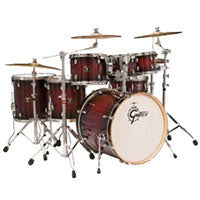
Acoustic Drum Sets
Acoustic Drum Sets The beat has been pounding away since there's been...


